
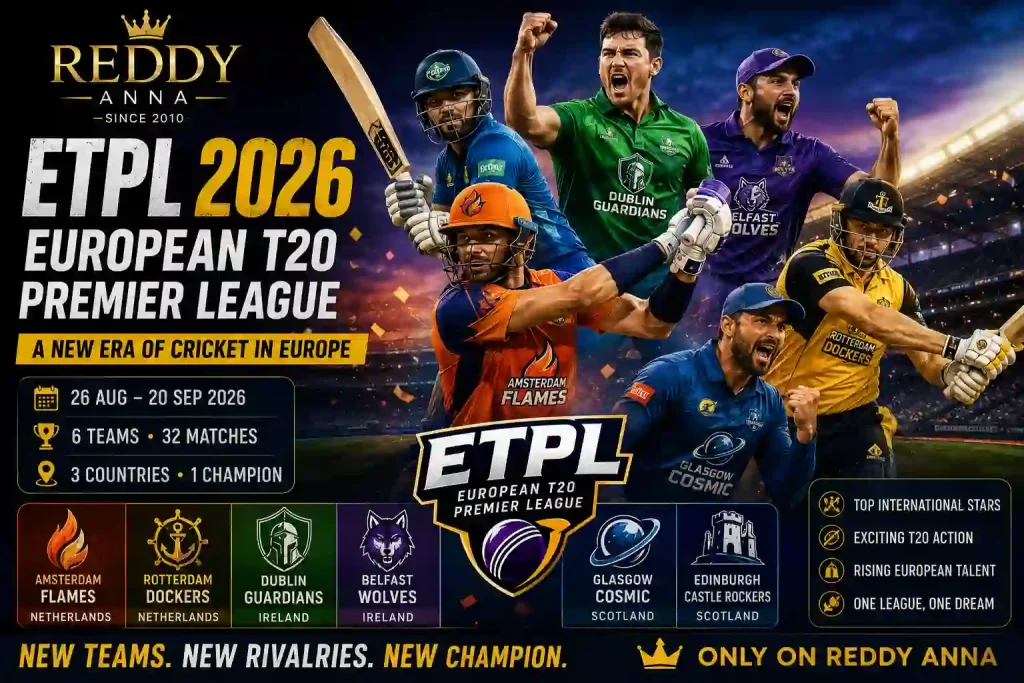
Reddy Anna ETPL 2026 Guide: Why the European T20 Premier League Could Change European Cricket
European cricket has usually lived outside the spotlight.
England has long had its domestic competitions, but countries such as Ireland, Scotland and the Netherlands have had far fewer opportunities to build a large franchise-cricket ecosystem of their own.
That changes with the European T20 Premier League (ETPL).
The inaugural ETPL 2026 season began on August 26, 2026 and is scheduled to run until September 20, 2026. Six city-based franchises from Ireland, Scotland and the Netherlands are competing in the new T20 competition.
For cricket fans following the tournament through Reddy Anna, ETPL offers something genuinely different. It isn’t simply another short-format league added to an already crowded calendar. It brings established international players together with emerging European cricketers in a competition specifically designed to grow franchise cricket across Europe.
Here is what makes ETPL worth watching.
What Is the European T20 Premier League?
The European T20 Premier League, commonly known as ETPL, is a franchise-based Twenty20 cricket competition involving teams from:
Ireland
Scotland
Netherlands
The competition is ICC-sanctioned and has been created through collaboration involving the cricket boards of the three founding countries.
Instead of national teams competing against one another, ETPL uses city-based franchises.
That gives the competition a familiar structure for fans who already follow leagues such as the IPL, BBL, SA20 or other franchise tournaments.
The difference is the location.
ETPL is trying to build that same franchise culture in a part of Europe where professional T20 cricket still has considerable room to grow.
ETPL 2026 Teams
Six teams are competing in the inaugural season.
They are:
Amsterdam Flames
Representing Amsterdam and Dutch cricket.
Rotterdam Dockers
Another Netherlands-based franchise representing Rotterdam.
Dublin Guardians
One of Ireland’s two ETPL teams.
Belfast Wolves
The second Irish franchise in the competition.
Glasgow Cosmic
Representing Glasgow and Scottish cricket.
Edinburgh Castle Rockers
Scotland’s second franchise.
The six teams therefore create an even geographical split:
2 Irish teams + 2 Scottish teams + 2 Dutch teams.
Why ETPL Is Different From Most New T20 Leagues
Plenty of new T20 tournaments have appeared over the years.
What makes ETPL particularly interesting is its attempt to connect three European cricket systems rather than operating entirely within one country.
Ireland, Scotland and the Netherlands already have international cricket traditions.
What they have historically lacked is the type of large franchise environment that allows domestic players to regularly share dressing rooms with established international names.
ETPL could help bridge that gap.
Local European Players Are Central to ETPL
One of the strongest ideas behind the tournament is that local players are not supposed to become background figures.
According to Cricket Ireland, each squad includes a minimum of seven local players from Ireland, Scotland or the Netherlands, plus at least one player from another European nation outside those three boards.
That matters.
A league can bring in famous overseas players and attract attention.
But long-term value comes when domestic players receive:
More professional matches
Higher-level opposition
Better coaching environments
Pressure experience
Exposure to international teammates
For European cricket, that development pathway may ultimately matter more than the headline names.
International Stars Add Another Level
The ETPL has also attracted recognizable players from international cricket.
The official tournament website lists names including:
Ajinkya Rahane
Lungi Ngidi
Keshav Maharaj
among its participating players.
The Dutch cricket board has also promoted the tournament around international names such as Glenn Maxwell, Ravichandran Ashwin, Faf du Plessis and Heinrich Klaasen.
For younger European players, sharing a squad with cricketers of that experience can be extremely valuable.
There is a difference between watching an international player on television and actually training beside one.
Why ETPL Could Matter for Dutch Cricket
The Netherlands has produced some excellent international performances.
Dutch cricket has repeatedly shown that it can compete with stronger cricket nations, particularly in limited-overs formats.
But domestic visibility has remained limited.
ETPL gives Dutch cricket two city franchises:
Amsterdam Flames
Rotterdam Dockers
and brings international franchise cricket directly to the Netherlands.
Matches during the Dutch stage are being played in Voorburg, giving local supporters an opportunity to watch franchise-level cricket at home.
That could be particularly important for attracting younger audiences.
Why ETPL Matters for Ireland
Ireland’s cricket story is different.
The country achieved Test status in 2017, but maintaining a strong professional structure has remained challenging.
A successful franchise competition could provide Irish players with more high-level cricket without requiring them to travel to leagues elsewhere.
Dublin and Belfast now have their own ETPL franchises.
That gives Irish supporters a new type of domestic rivalry:
Dublin Guardians vs Belfast Wolves.
City-based rivalries are often what help franchise competitions develop identity.
Scotland Gets Its Own Franchise Rivalry
Scottish cricket also gains two franchises:
Glasgow Cosmic
Edinburgh Castle Rockers
Glasgow against Edinburgh already carries obvious sporting rivalry.
Putting those cities into a T20 franchise structure gives ETPL something leagues need badly:
matches that mean more than just league-table points.
If supporters begin identifying strongly with their city franchises, that rivalry could become one of ETPL’s most valuable long-term assets.
ETPL 2026 Format
The inaugural competition features a league stage followed by knockout matches.
According to the official ETPL guide, the tournament contains:
30 league-stage games
followed by:
Qualifier
Final
for 32 matches in total.
The season runs from:
August 26 to September 20, 2026.
That gives fans almost four weeks of T20 cricket.
Why Indian Cricket Fans May Find ETPL Interesting
Although ETPL is European, it has plenty of reasons to attract attention from Indian cricket followers.
The obvious one is player familiarity.
International names immediately make a new league easier to follow.
But there is another reason.
Indian audiences have become extremely comfortable with franchise cricket.
Fans understand:
Auctions and squads
Overseas-player combinations
City franchises
Powerplay tactics
Death bowling
Matchups
Live T20 momentum
ETPL uses a format that feels familiar even though the teams and venues are new.
For users following cricket on Reddy Anna, that combination of familiar T20 structure and unfamiliar European conditions can make ETPL particularly interesting.
European Conditions Could Make ETPL Tactically Different
This may be the most interesting cricketing part of ETPL.
European conditions are not necessarily going to behave like typical subcontinental T20 surfaces.
Weather can have a major influence.
Depending on the venue and day, players may encounter:
Cloud cover
Moisture
New-ball movement
Cooler temperatures
Changing wind
Slower outfields
That can make team selection and batting approach important.
A strategy that works on a flat, dry surface may need to change completely in moving-ball conditions.
Watch the First Three Overs Closely
During ETPL games, the first few overs could provide valuable information.
Look for:
Swing
Is the new ball moving through the air?
Seam
Is it changing direction after pitching?
Bounce
Is the wicketkeeper collecting comfortably?
Timing
Are batters hitting cleanly through the line?
Outfield Speed
Are well-timed shots reaching the boundary?
European conditions can change quickly, which means pre-match assumptions may not survive the opening spell.
Powerplay Strategy Could Decide ETPL Matches
T20 teams naturally want to maximize the powerplay.
But aggressive batting does not always mean attacking every delivery.
If the new ball is moving, losing three wickets while chasing an extra 15 runs can be a poor trade.
The best teams will need to judge conditions quickly.
On one day:
60/1 after six overs may be realistic.
On another:
43/1 could represent an excellent powerplay.
Context matters.
Overseas Stars vs Local Knowledge
This creates an interesting tactical battle.
An overseas international may arrive with enormous experience.
A local Dutch, Irish or Scottish player may understand the ground and conditions better.
That knowledge can matter.
Local players may already know:
Which side of the ground is shorter
How the wind normally behaves
Whether the surface slows down
How evening conditions change
Which lengths work best
Franchise cricket becomes more interesting when superstar reputation meets local expertise.
ETPL Could Create New European Cricket Stars
Every franchise tournament needs breakout players.
The IPL has repeatedly turned relatively unknown domestic players into household names.
ETPL now has the opportunity to do something similar for European cricket.
A young local batter does not need to dominate the entire season.
Sometimes all it takes is:
One 70-run innings
A brilliant death over
A four-wicket spell
A memorable catch
A match-winning final over
Suddenly supporters remember the name.
That visibility could be one of ETPL’s biggest contributions to European cricket.
What Reddy Anna Users Should Watch During ETPL
Instead of looking only at the final score, pay attention to a few live-match indicators.
1. Powerplay Wickets
European new-ball conditions may make early wickets particularly important.
2. Local Player Contributions
See which emerging players handle the pressure of franchise cricket.
3. Overseas Player Matchups
Experienced internationals facing unfamiliar local bowlers can create interesting contests.
4. Pitch Conditions
Don’t assume every venue or match will play identically.
5. Death Bowling
The final four overs remain one of the most important phases of any T20 innings.
6. Partnerships
One stable partnership can completely change a short-format game.
Don’t Judge a New League Too Quickly
The first season of any competition is rarely perfect.
Teams are still creating identities.
Supporters are learning the players.
Rivalries are only beginning.
Organizers are discovering what works and what needs adjustment.
The real question is not whether ETPL immediately looks like the IPL.
That would be an unrealistic comparison.
The better question is:
Can ETPL build something European cricket did not have before?
If the answer becomes yes, the league could matter far beyond its first season.
Could ETPL Help Cricket Grow Across Europe?
That is the larger story.
Cricket has significant established communities across Europe, but professional opportunities are still limited compared with the sport’s biggest markets.
A successful ETPL could potentially help through:
Increased visibility
More professional opportunities
International player exposure
New sponsorship
Younger audiences
Stronger local franchises
The tournament itself describes its ambition as growing cricket’s footprint across Europe.
Whether it achieves that will take more than one season to determine.
But the opportunity is clearly there.
ETPL and the Future of Franchise Cricket
Franchise cricket is expanding.
The IPL demonstrated how powerful the model could become.
Since then, major T20 leagues have developed across:
Australia
South Africa
UAE
USA
Caribbean
Other cricket markets
Europe outside England has largely been missing from that map.
ETPL is attempting to fill that space.
That alone makes its first season worth watching.
Following ETPL on Reddy Anna
For cricket followers using Reddy Anna, ETPL adds another T20 competition with unfamiliar teams, new player combinations and different playing conditions.
Before following any match closely, look at:
Confirmed playing XI
Venue
Pitch conditions
Weather
Player roles
Recent performances
Toss result
And once the game begins, update your view based on what is actually happening.
A pre-match prediction should never become more important than live evidence.
Responsible Sports Gaming
ETPL may offer another exciting cricket competition to follow, but real-money sports gaming always carries financial risk.
No team, player or statistical pattern provides a guaranteed result.
Users should:
Set a fixed budget
Avoid chasing losses
Never borrow money to gamble
Take regular breaks
Avoid emotional decisions
Treat sports gaming as entertainment
Follow applicable age requirements and local laws
Good cricket analysis helps you understand a match.
It does not make cricket predictable.
FAQs About ETPL 2026
What does ETPL stand for?
ETPL stands for the European T20 Premier League.
When did ETPL 2026 start?
The inaugural season began on August 26, 2026.
When is the ETPL 2026 final?
The tournament is scheduled to conclude on September 20, 2026.
How many teams are in ETPL?
Six city-based franchises are competing.
Which countries are represented?
Ireland, Scotland and the Netherlands.
Which teams are playing in ETPL 2026?
The teams are Amsterdam Flames, Rotterdam Dockers, Dublin Guardians, Belfast Wolves, Glasgow Cosmic and Edinburgh Castle Rockers.
Is ETPL an officially sanctioned competition?
Yes. ETPL describes itself as an ICC-sanctioned competition.
Why is ETPL important for European cricket?
It gives local players from Ireland, Scotland and the Netherlands more opportunities to compete in a franchise environment alongside experienced international players.
Final Thoughts
ETPL arrives at an interesting moment for cricket.
Franchise tournaments are everywhere, yet much of continental European cricket still feels like unexplored territory.
That is what makes this league different.
The European T20 Premier League is not simply introducing six new team names.
It is testing whether Ireland, Scotland and the Netherlands can build a shared franchise competition with enough quality, identity and support to become part of the international T20 calendar.
For fans following ETPL through Reddy Anna, there will be obvious attractions: international stars, quick matches, changing conditions and unfamiliar team combinations.
But the more important story may take longer to develop.
A young European player becoming a star.
A Glasgow-Edinburgh rivalry growing.
Amsterdam and Rotterdam building cricket followings.
Dublin and Belfast creating another sporting contest.
If those things happen, ETPL will have achieved something far more valuable than simply adding another T20 trophy.
It will have given European cricket a new stage.